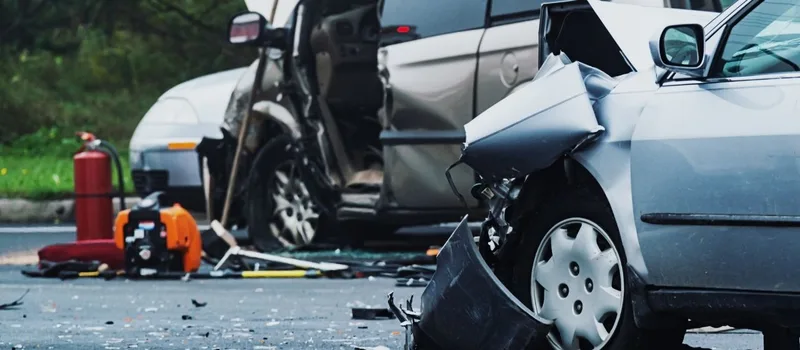

Get everyone to safety, call 911, get checked by a medical provider the same day, and document the scene before you say a word to any insurance company. Those four moves, in roughly that order, protect your health and your claim more than anything else you'll do after a Colorado crash.
I have read hundreds of client files where the accident itself was the easy part to understand — it was the ninety minutes afterward that decided how the claim went. As a nurse before I was a lawyer, I have also sat with patients who insisted they were “fine” at the scene and were in a cervical collar three days later. This is the order I actually recommend, built around both realities.
What should I do in the first few minutes after a Colorado car accident?
- First problem to solve, before anything else: if the cars still run and somebody's sitting in an active lane, get out of traffic. Nobody gets helped from there.
- Next, hazards on. And if there happen to be flares or triangles buried in the trunk somewhere, a stretch like US-160 at dusk is exactly when digging them out pays off.
- Before you even glance at the bumper, check on yourself and everyone in the car. Adrenaline lies about pain more than people realize.
- Then call 911 — yes, even for a low-speed fender-bender, and here's the reason that matters more than it seems.
That last point trips people up constantly. A minor-looking accident with no visible damage and no obvious injury still deserves a call to 911, because the police report becomes one of the few neutral, contemporaneous records of what happened. Without it, the story often turns into your word against the other driver's — weeks later, after memories have already softened.
Do I need to see a doctor even if I feel fine?
This is the piece I push hardest as a nurse. Adrenaline and cortisol are powerful pain blockers in the first hour after a collision, and soft-tissue injuries — whiplash, disc irritation, a mild concussion — often do not announce themselves until the next morning, or the one after that. If paramedics are on scene, let them assess you. If you decline transport, still see a doctor, an urgent care provider, or an ER within 24 hours.
Key takeaway: a same-day or next-day medical visit does two things at once — it catches injuries before they get worse, and it creates the timestamped medical record that ties your injury to the crash. A five-day gap between the accident and your first visit is exactly the gap an insurance adjuster will point to.
What should I document at the scene before I leave?
- Photograph all vehicles from several angles, including license plates, damage, and the surrounding road — lane markings, signals, skid marks, weather.
- Photograph any visible injuries as they appear that day; bruising often looks worse, not better, 48 hours later, and a same-day photo anchors the timeline.
- Exchange name, phone number, insurance company, and policy number with the other driver — never just a photo of their license.
- Get a name and phone number from any witness before they drive off — once they're gone, tracking them down later is close to impossible.
Do this even when the police are already on scene taking their own photos. Officers document what matters for a citation; your photos protect what matters for your claim, and those are not always the same details.
What shouldn't I say at the scene?
“I'm sorry” feels automatic after a crash, and I understand the instinct — but it is one of the first things an insurance adjuster looks for in a recorded statement or a witness account. Stick to facts with the responding officer: where you were, what direction you were traveling, what you saw. Save the causation debate — who had the right of way, who was following too closely — for your attorney and the evidence, not an apology you offer out of politeness in the middle of the road.
Should I report to my insurance company or the other driver's?
Notify your own insurance company promptly; most policies require it, and it starts your claim moving. Be more careful with the other driver's insurance company. Their adjuster's job is to minimize the payout, and a recorded statement given a day or two after a crash — before you know the full extent of your injuries — can be used against you later. It is reasonable to give basic facts and decline a recorded statement until you have spoken with an attorney, particularly if you were hurt.

How do I track my recovery and protect my claim?
Keep every discharge summary, imaging report, and physical therapy note. Keep pay stubs or a note from your employer if the injury cost you work time. I also recommend a short daily note — a sentence or two on pain level, sleep, what you could not do that day — because insurers routinely undervalue injuries that do not show up neatly on an X-ray, and a contemporaneous record is far more persuasive than a memory reconstructed months later.
When should I bring in a lawyer?
Not every fender-bender needs an attorney. But a few signs mean it is worth a free conversation early: an injury that requires more than a couple of urgent-care visits, an insurer disputing fault or hinting that you share the blame, a settlement offer that arrived faster than your treatment finished, or simple uncertainty about your filing deadline. Colorado also applies a comparative-negligence rule that can reduce or bar your recovery if you are found partly at fault — our guide to comparative negligence breaks that down, and it is exactly the kind of issue an adjuster will raise before you've had a chance to.
Colorado also puts a real clock on your right to file — our guide to Colorado's filing deadlines covers exactly how long you have, and it is shorter than most people assume. The safest move is to have that deadline confirmed early, even if you are not ready to decide whether to pursue a claim.
If a vehicle was involved in your injury, our Durango car accident attorney page explains how we build these cases from the medical record up — and a free consultation costs nothing to find out where you stand.
Questions about your own accident? Shannon Soignier, RN, JD offers free consultations across Durango and the Four Corners.
Durango Car Accident Attorney